

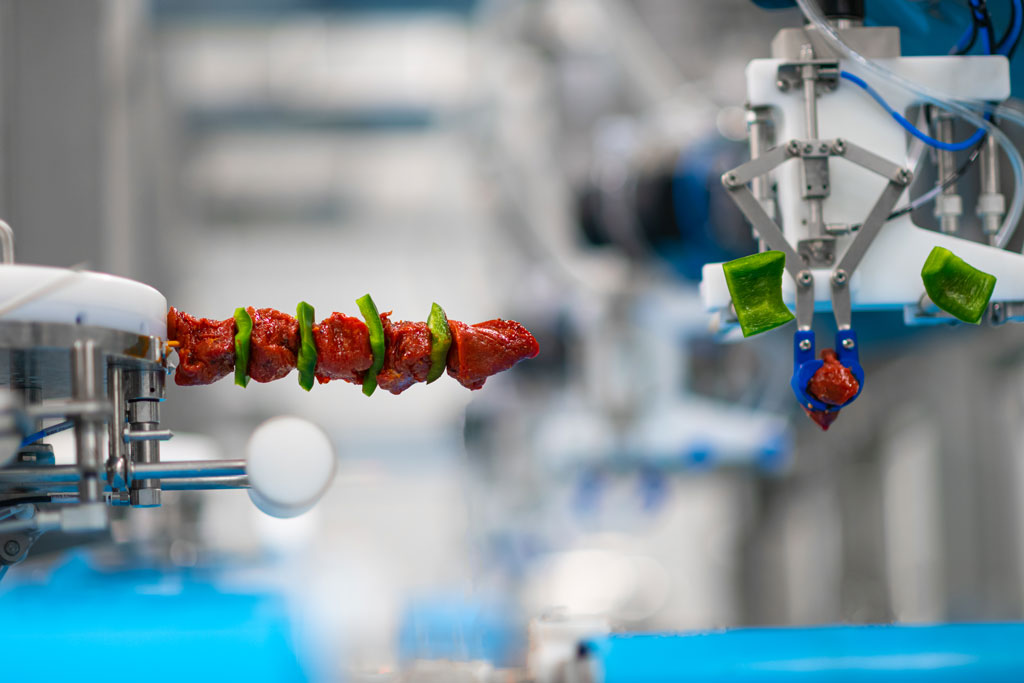
Automatic skewering machine
World's first fully automatic skewering machine
The Customer
Beltaste, born out of the Limburg family business Vanreusel Snacks (1953), is the Belgian market leader in frozen meat snacks. The company supplies the entire foodservice industry: from recognisable classics under its own brands to private labels for retail, B2B and halal.
Beltaste has three production sites: Hamont (Belgium) for cooking and frying products, Mórahalom (Hungary) for skewered products such as satays and brochettes, and Oma Bobs in the Netherlands for croquettes and bitterballen. Together they account for a turnover of €79 million and more than 355 employees.
The Challenge
At the production site in Mórahalom, thousands of brochettes are produced daily for the European market. Piercing was always manual work. Repetitive, labour-intensive, and increasingly difficult to sustain. Finding and retaining suitable staff became more challenging every year. The competitive position was under pressure.
There are skewering machines on the market. But none met Beltaste's requirements. All existing machines still require many hands to put ingredients into compartments. Final product quality leaves much to be desired and too many non-conforming products come out. And speed is still determined by the operators, not the machine.
Why this is not a standard machine:
-
Unpredictable ingredients: Pieces of meat, onions, peppers, cherry tomatoes: each different in shape and size.
-
Singulation and positioning: Ingredients should be automatically selected from a bulk and placed preconditioned
-
Hygiene requirements: The food industry has strict requirements for materials, cleanability and food safety.
-
Crafted quality: The final product should look better than handmade, not worse.
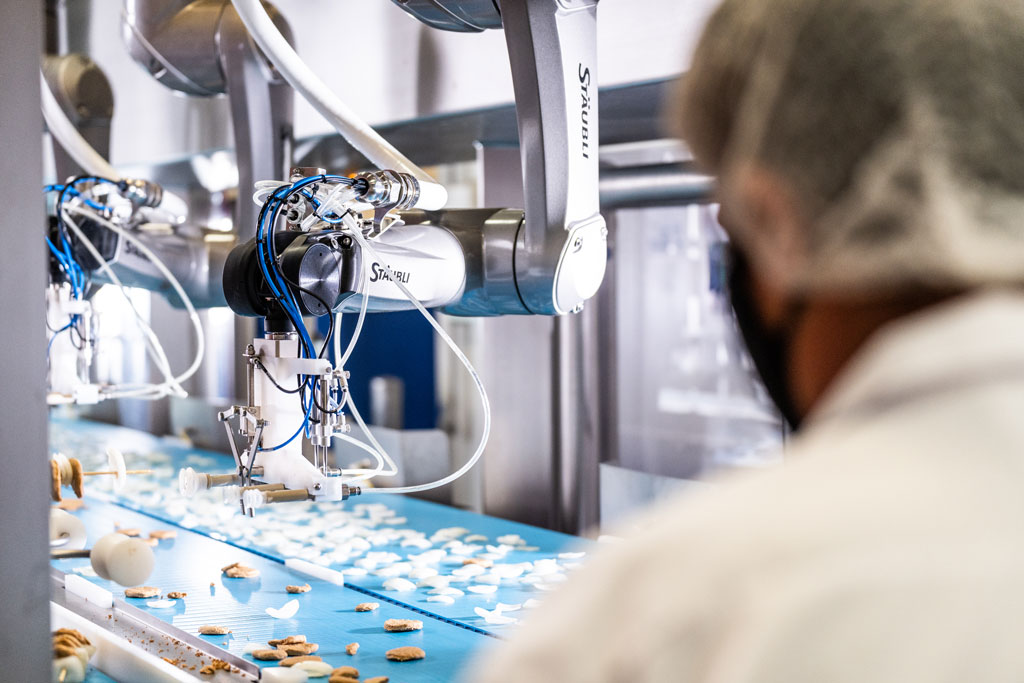
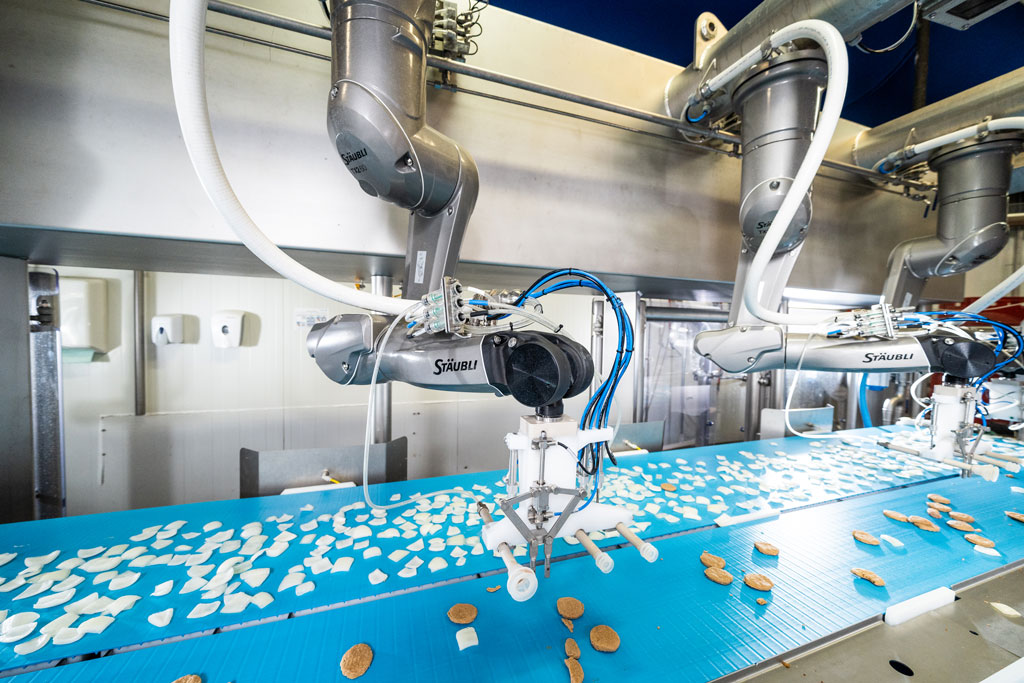
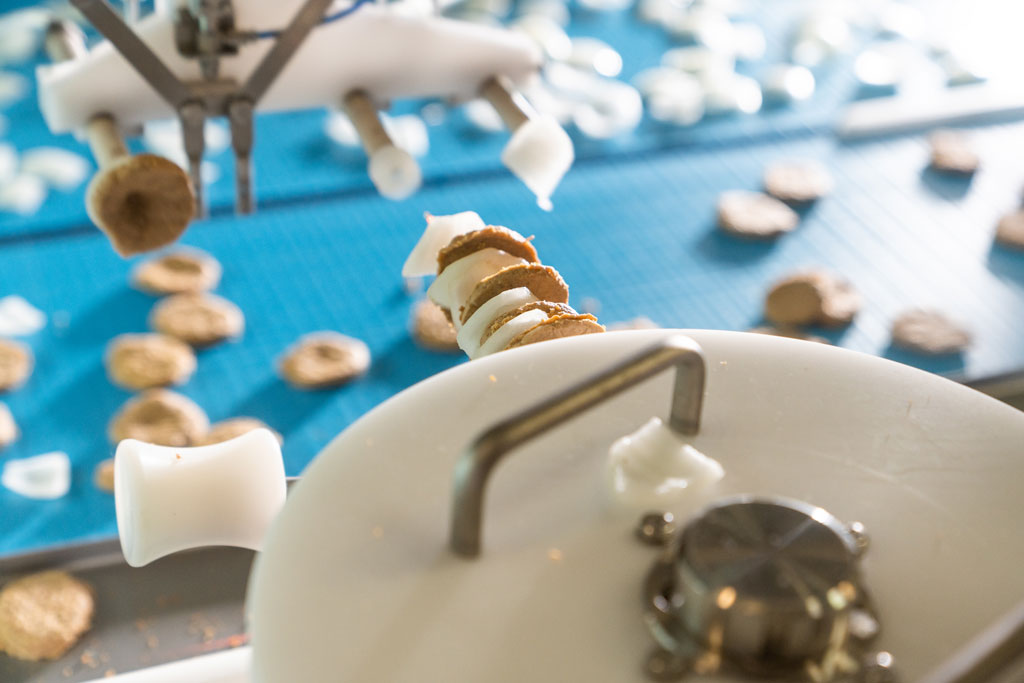
Project Gallery
SMO's Solution
Pick & Skewer: a world first in food automation
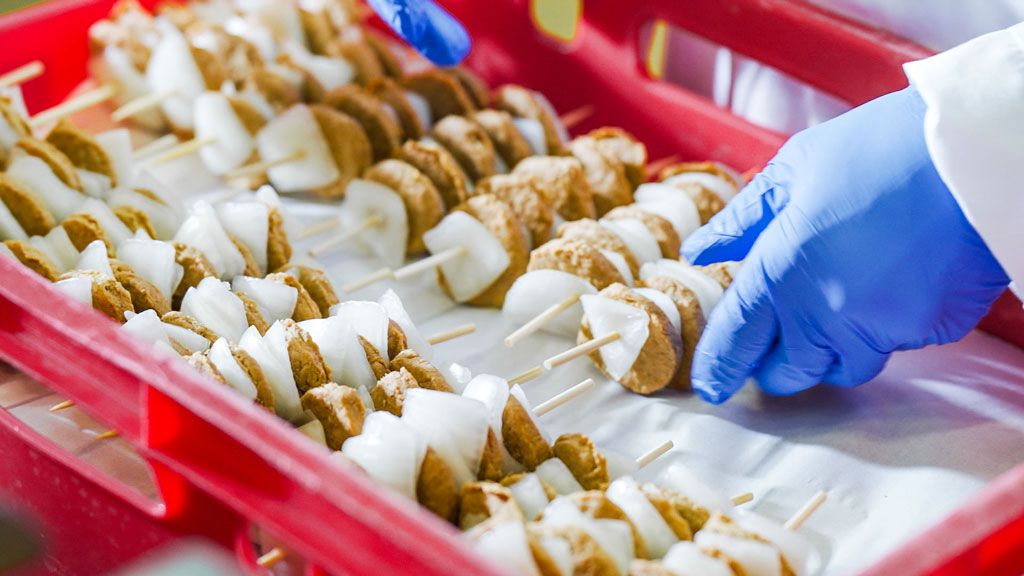
SMO, through PINTRO, developed the Pick & Skewer: a fully automatic line where pre-cut pieces of meat and vegetables are placed in a hopper, sticks are placed in a basin, and the machine does the rest. At the end, perfectly skewered brochettes come out, according to the customer's specifications.
The smart combination of vision, robotics and custom-designed grippers makes this possible. Ingredients are automatically singulated, recognised and pinned onto the stick at high speed. The system was patented.
Automatic singulation
A system that extracts ingredients from bulk and offers them to the robot one by one. No hands needed to fill boxes.
Vision and customised grippers
Every onion, every tomato, every piece of meat is different. Vision recognises the position, custom-designed grippers grab the product without damage.
Engineering and production under one roof
The combination of unpredictable products, high speed and strict hygiene requirements made this project a puzzle where all disciplines had to work together. Mechanics, vision, software and gripper technology were developed and tested in parallel. With everything under one roof, the team was able to iterate quickly until the system did what it needed to do.
The machine in action
The Result
The first Pick & Skewer was commissioned in 2019. A second followed in 2020. A third plant will be installed in August 2026. That Beltaste keeps coming back says it all.
The machines run up to 22 hours a day, 5 days a week, all year round. Each plant produces more than 1,000 brochettes per hour with only one logistics operator. The quality is more consistent than with manual work, and the savings in personnel costs are almost 90%.
We spent a very long time looking for a solution that would increase productivity while improving quality. No solution met our needs. When we saw the Pick & Skewer, we were immediately convinced.
Technical Specifications
- Type Fully automatic skewering machine
- Product Shish kebabs and skewered products
- Capacity 1,000-1,200 pieces per hour
- Key technology Vision, robotics, patented grippers
- Operators 1 (logistics)
- Completion 2019 (1st), 2020 (2nd), 2026 (3rd)